
Trinity Series
The Trinity Series marks the beginning of my artistic journey. Before I explored the wisdom of nature, I was drawn inward, searching for a sense of balance and belonging within myself. I was fascinated by sacred geometry and the quiet language of the mandala. What first attracted me was its beauty, but as I spent more time painting, I discovered something much deeper. Every circle, line, and pattern became a way of making sense of the world around me and the world within me.
For me, the mandala is more than a decorative form. It is a visual language that expresses the invisible structures connecting our inner and outer worlds. Inspired by sacred geometry, each painting reflects the search for balance in the complexity of everyday life, reminding us that growth begins from within and that every journey toward wholeness is both deeply personal and universally shared.


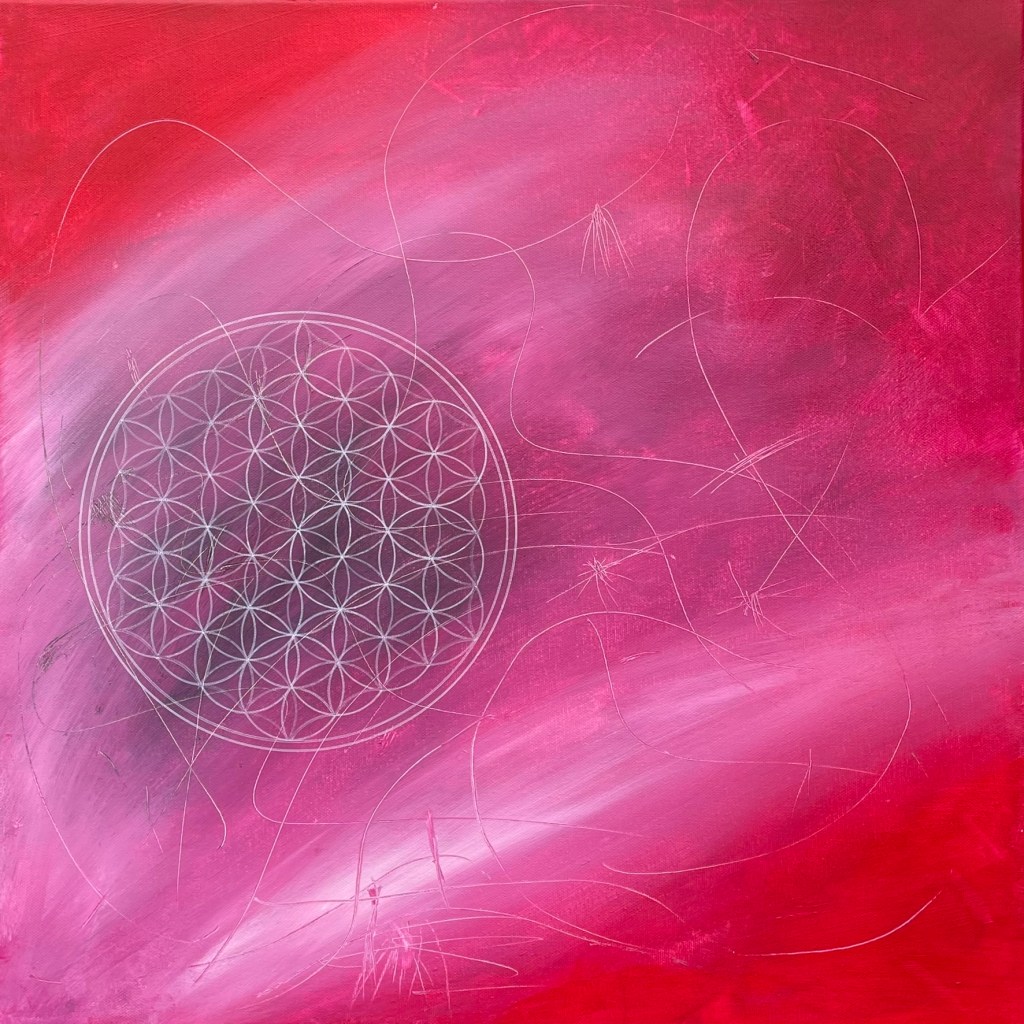

Inspired by the profound unity that exists throughout creation, this series explores the connection between mind, body, and spirit. Sacred geometry became the visual language through which I could express what cannot always be seen: the invisible threads that connect us to ourselves, to one another, and to the universe. It reminded me that nothing in nature exists in isolation. Every shape, every colour, and every form carries meaning and belongs to something greater.
The series consists of twenty-four paintings, arranged in groups of three. Each group is dedicated to a single colour, exploring its emotional, symbolic, and energetic qualities. Magenta, green, yellow, mossy beige, grey and white, turquoise, violet and blue each become a meditation on a different aspect of our inner world. Together, they form a visual journey through balance, transformation, and the many dimensions of human experience..


Creating these paintings became much more than an artistic practice. It became a form of meditation, self-discovery, and quiet reflection. Layer by layer, the paintings evolved alongside me, revealing their own rhythm while inviting me to trust intuition as much as structure. Acrylic paint, texture paste, and fluid mediums build rich, tactile surfaces where geometric precision meets organic movement. Every composition balances structure with spontaneity, reflecting the harmony that exists between order and intuition.
The Trinity Series reflects my belief that harmony is not something we find outside ourselves, but something we gradually uncover within. Each painting invites viewers to pause, look inward, and reconnect with the deeper patterns that unite all life. Looking back today, I see this series as the foundation of everything that followed. It was here that I began exploring the invisible connections that later blossomed into my Nature Series, where those same universal patterns reveal themselves through the wisdom and beauty of the natural world.

Merkaba of Happiness. This work explores the sacred geometry of the Merkaba — a three-dimensional star tetrahedron formed by two interlocking pyramids rotating in opposite directions. Rooted in ancient Hebrew mysticism, the word “Merkaba” translates as light (Mer), spirit (Ka), and body (Ba) — symbolizing a vehicle of light that unites physical and spiritual dimensions.
Rendered in luminous gold against a tranquil blue field, the geometric structure radiates harmony and equilibrium. The interlocking tetrahedra represent the balance of dual forces — masculine and feminine, movement and stillness, heaven and earth.
The circular forms surrounding the central star amplify the sense of expansion and energetic protection, while the ornamental patterns evoke both cosmic rhythm and inner awakening.
This piece invites contemplation. It is a meditation on alignment — where light, consciousness, and embodiment converge.
The Merkaba is traditionally associated with:
• Spiritual activation
• Energetic protection
• Transformation and ascension
• Healing and balance
In this interpretation, happiness is not fleeting emotion — it is harmony within structure. A state of geometric alignment between body, spirit, and light.
Serenity: The Architecture of Creation is a contemporary interpretation of one of the most profound symbols in sacred geometry – Metatron’s Cube. Composed of thirteen interconnected circles and intricate golden linework, the composition reveals the hidden architecture of existence. Within its structure reside the five Platonic solids — the tetrahedron, cube, octahedron, dodecahedron, and icosahedron — the fundamental geometric forms long considered the building blocks of the universe. Set against a serene blue background accented with refined ornamental details, the golden geometry radiates balance, precision, and harmony. The interplay between celestial blue and luminous gold evokes both tranquility and spiritual elevation. This piece symbolizes interconnectedness, divine order, and the unity underlying all living things. It invites contemplation and serves as a visual meditation on creation, symmetry, and universal intelligence. Ideal for collectors drawn to sacred symbolism, spiritual philosophy, and refined geometric abstraction


Journey explores the primordial structure known as the Seed of Life — a sacred geometric formation composed of seven interlocking circles symbolizing the genesis of creation. Recognized as the foundational blueprint of the Flower of Life, this form represents fertility, expansion, and the interconnected evolution of all living systems. Rendered in luminous gold against a deep celestial blue, the composition emphasizes harmony, symmetry, and cyclical movement. Each overlapping circle signifies a developmental phase — a passage from origin to complexity, from unity to multiplicity. The work invites contemplation of nature’s hidden order — suggesting that life unfolds through precise geometric intelligence. Journey becomes both a meditation on beginnings and a visual reflection on the continuity that binds all existence.
The attached painting interprets the Seed of Life through a rich palette of magenta, violet, and gold. At its centre, seven overlapping circles form the foundational geometry associated with creation, fertility, and the origins of life. Each circle can be understood as a stage in the unfolding of creation, expressing the idea that every beginning is connected to what comes before and what comes after.Surrounded by intricate floral and geometric elements, the Seed of Life becomes more than a symbol. It becomes a visual meditation on interconnectedness, growth, and the hidden order within life. The layered composition reflects the relationship between the individual and the greater whole, while the vibrant colours bring energy, warmth, and a sense of transformation.As one of the fundamental forms of sacred geometry, the Seed of Life is also considered the starting point of the more complex Flower of Life. In this painting, it represents the moment of becoming, the first pattern from which something greater can unfold.

The Star: This painting explores the symbolism of the hexagram, a six-pointed star formed by two interlocking equilateral triangles. At the heart of the composition, the opposing triangles meet to create a powerful symbol of balance, unity, and harmony. Across different traditions, the hexagram represents the union of complementary forces, such as masculine and feminine, spirit and matter, inner and outer, and movement and stillness. Their intersection suggests that seemingly opposite energies can exist together and create something whole. The central star is surrounded by layers of intricate geometric patterns, creating a sense of order, movement, and interconnectedness. The vivid magenta and gold palette adds warmth and intensity, while the repeated forms draw the eye inward toward the centre. In Jewish tradition, the hexagram is known as the Star of David, or Magen David, and represents Jewish identity and community. In Hindu tradition, the related Shatkona symbolizes the union of masculine and feminine energies and appears in yantras as a representation of balance and creation. In this work, the star becomes a universal reflection on connection, harmony, and the meeting of opposing forces.
The Web: The Web is a mandala inspired by the intricate geometry of interconnected lines, circles, and radial patterns. At its center, a luminous geometric form emerges from a dense network of intersecting lines, creating a visual sense of movement, connection, and balance.The web represents the invisible connections that weave through life. Every line meets another, suggesting that our thoughts, emotions, actions, and intentions are never isolated. They form a larger pattern, connecting us with ourselves, with others, and with the world around us.The layered geometry creates a tension between structure and complexity, while the central form brings a sense of order and focus. The painting reflects the delicate balance between individuality and belonging, reminding us that even within an intricate web of connections, every element has its place.The Web invites us to pause and consider the relationships that shape our inner and outer worlds, and the unseen threads that connect us all.
Fruit of Life explores the sacred geometry of the 13 interlocking circles, a symbol associated with the fundamental structure and interconnectedness of life. At its centre, unity becomes the sustaining force from which all other forms emerge. The surrounding circles suggest the interconnected worlds and systems that form a greater whole, reflecting the relationships between matter, energy, nature, and existence. Geometric forms unfold within the circular structure, creating a balance between order and movement. Set against a luminous golden field, the work evokes the idea that beneath the visible world lies an underlying architecture connecting all life.
Reflections draws on the symbolism of Odin’s triangles, known as the Valknut, a powerful motif in Norse mythology associated with transition, transformation, and the mysteries of existence. The three interlocking triangles suggest the continuous relationship between life, death, and rebirth, forming a visual representation of the cyclical nature of life. Traditionally connected with Odin, the symbol also carries associations with wisdom, courage, and the journey between worlds. Through its layered geometry, the painting invites contemplation of the transitions we experience, both outwardly and within ourselves, and the ways each stage of life shapes the next.
Torus explores the idea of continuous energy, movement, and interconnectedness. In sacred geometry, the torus represents an endless flow that moves outward and returns inward, symbolising cycles of creation, transformation, and renewal. Its form can be found throughout nature, from magnetic fields surrounding the Earth and Sun to vortexes, flowers, and other patterns of organic growth. In this work, the concentric geometry creates a sense of movement within stillness, drawing the eye toward the centre and back outward again. Torus becomes a reflection on the invisible currents connecting life, matter, nature, and consciousness.
Tree of Life explores the enduring symbol of connection, growth, and the cycle of existence. Across cultures and traditions, the tree represents a bridge between the earthly and spiritual realms, with its roots grounded below and its branches reaching upward. Here, the tree is expressed through sacred geometry, creating a structured network of interconnected forms. Its repeated circles suggest the continuity of life and the relationships between all living things. Inspired by the Kabbalistic, Christian, Celtic, Egyptian, and Buddhist traditions, the work reflects the universal human search for connection, wisdom, and renewal..


Perspective draws on the symbolism of the dream catcher, a traditional object associated with the Ojibwa people of North America. Its circular form represents the cycle of life, while the woven structure reflects the connections between thought, experience, and the unseen. Traditionally, the web is believed to filter dreams, holding what is negative while allowing positive dreams to pass through. In this work, the dream catcher emerges subtly from layers of green, inviting the viewer to look beyond the visible surface. Perspective becomes a reflection on what we choose to hold, release, and allow into our lives.
Duality explores the Vesica Piscis, one of the foundational forms of sacred geometry. Created through the intersection of two circles, the shape represents the meeting of opposing yet complementary forces, such as the physical and spiritual, inner and outer, or heaven and earth. At its centre, two distinct forms become one, suggesting balance, harmony, and creation through connection. Used across spiritual traditions and Christian symbolism, the Vesica Piscis also serves as a foundation for more complex geometric patterns. In this work, it becomes a reflection on unity within difference and the interconnectedness of life.

Sunflower Mandala explores the relationship between nature, geometry, and inner balance through the form of the flower mandala. At its centre, the sunflower becomes a symbol of light, vitality, and growth, while its radial arrangement creates a sense of harmony and continuity. The repeated petals echo the natural order found in flowers and other organic forms, transforming the botanical motif into a geometric structure. Through the circular composition, the painting reflects the mandala as a symbol of wholeness, inviting the viewer to pause, find balance, and reconnect with the quiet rhythm of nature..
Nelumbo Mandala explores the lotus as a symbol of rebirth, purity, enlightenment, and self-renewal. Rooted in muddy waters yet rising above the surface to bloom, the lotus reflects the possibility of transformation and growth through life’s challenges. Its circular mandala form brings these ideas into a visual language of balance, repetition, and harmony. The unfolding petals suggest an inner journey, where each layer reveals another stage of becoming. Through the meeting of botanical form and sacred geometry, the painting invites a moment of stillness and reflection on our own capacity for renewal..
Flower of Life Mandala explores the ancient geometric pattern of interlocking circles as a symbol of creation, unity, and the cycle of life. Emerging from a single central point, the repeated circles expand outward, suggesting that all forms of existence originate from one source and remain connected. Unlike a flower found in nature, the Flower of Life is an abstract floral form created through geometry and repetition. In this work, the circular structure becomes a visual meditation on interconnectedness, balance, and the continuous movement between the individual and the greater whole.
Expansion explores the mandala as a symbol of movement, connection, and the continuous cycles of life. Rooted in the Sanskrit word for “circle” or “centre,” the mandala reflects the idea that life is never static, but constantly unfolding, returning, and transforming. From a central point, its geometric forms extend outward, creating a sense of growth and interconnectedness. Originating as a spiritual symbol in Buddhist and Hindu traditions, the mandala has become a universal visual language of balance and contemplation. In this work, expansion becomes a metaphor for personal growth and the widening awareness of our connection to the world around us.
Creation explores the Flower of Life as a visual expression of unity, balance, and the interconnectedness of all life. Formed by evenly spaced, overlapping circles, its harmonious structure reveals a network of geometric forms within a single pattern. Throughout history, the Flower of Life has appeared across cultures and spiritual traditions as a symbol of creation and the underlying unity of existence. It also serves as a foundation for sacred geometry forms such as Metatron’s Cube, the Merkaba, Sri Yantra, and the Tree of Life. In this work, geometry becomes a language through which creation unfolds from one interconnected whole.
Gold Sri Yantra explores one of the most revered forms of sacred geometry, symbolising the union of divine masculine and feminine energies, the cosmos, and the individual soul. Interlocking triangles create a dynamic balance between opposing forces, reflecting the harmony underlying creation and existence. At the centre, the geometry draws the viewer inward, representing a journey from the outer world toward the inner self, from the physical toward the spiritual, and from the visible toward the unseen. The luminous gold tones enhance this sense of sacredness, warmth, and inner illumination, transforming geometry into a meditation on unity and consciousness.

The Triquetra explores the ancient Trinity Knot, a continuous form made of three interwoven arcs. Found across Celtic, Norse, and Christian traditions, the symbol has carried different meanings throughout history, often connected to ideas of unity, continuity, and the relationship between three elements. In this work, the delicate white geometry emerges from a textured field of grey and gold, creating a contrast between structure and spontaneity. The surrounding layers suggest movement, change, and the traces left by experience. At its centre, the Triquetra becomes a quiet reflection on connection, balance, and the continuous nature of life.
Inspired by the Celtic figure of Merlin Ambrosius, this work reflects the timeless connection between nature, wisdom, and the unseen. Rooted in Welsh and Breton traditions, Merlin is remembered as a sage, prophet, and keeper of ancient knowledge, often associated with the wisdom of the druids. In this painting, his story becomes a meditation on the relationship between the natural and mystical worlds. The layered forms and organic details suggest a sense of transformation, inviting the viewer to look beyond what is immediately visible and consider the deeper forces that shape our lives..
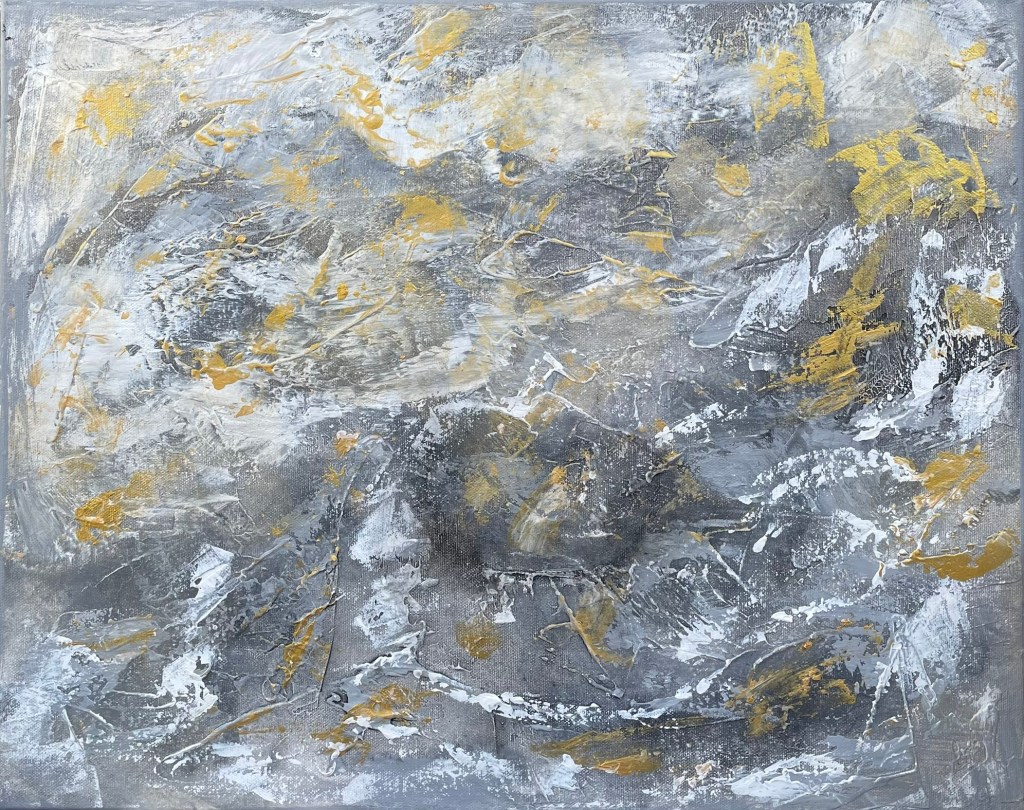

Celtic Triangle Flower
Inspired by the ancient Triquetra, this work explores the idea of three elements coming together to form a unified whole. The interwoven forms suggest the balance between Earth, Air, and Water, as well as the connection of Mind, Body, and Soul. They can also be read as a reflection of Past, Present, and Future, each part connected to the others while remaining distinct. At the centre, the floral form brings a sense of growth and renewal, turning the ancient symbol into a meditation on balance, connection, and the continuous movement of life.
Inspired by the sacred geometry of the Durga Yantra, this work reflects the strength, protection, and transformative power of the divine feminine. Associated with the Hindu goddess Durga, the yantra is traditionally regarded as a spiritual tool for invoking courage, guidance, and inner strength. The geometric structure creates a sense of balance and focused energy, while the layered forms suggest movement from the outer world toward an inner centre. Through colour, symmetry, and intricate pattern, the painting becomes a meditation on resilience, protection, and the power to overcome forces that stand in the way of growth.


Kali Yantra explores the transformative energy associated with the Hindu goddess Kali, a powerful symbol of destruction, creation, and liberation. Traditionally used as a tool for meditation, the Kali Yantra brings together geometric forms such as triangles, circles, and lotus petals, converging toward the central bindu, which represents the divine essence. In this work, the geometry becomes a visual expression of transformation, where the release of what no longer serves us creates space for renewal. The painting reflects Kali’s qualities of strength and protection, inviting us to face fear, release negativity, and move toward greater freedom.
Shiva Yantra explores the sacred geometry associated with Lord Shiva, a central figure in Hinduism and a symbol of transformation, wisdom, and spiritual awareness. Traditionally used for meditation and spiritual practice, the yantra represents the union of masculine and feminine energies and the balance between creation and destruction. Its geometric structure becomes a visual pathway inward, reflecting the journey toward inner peace, clarity, and liberation. In this work, the interplay of form, colour, and symmetry creates a sense of stillness within movement, inviting contemplation of the forces that shape transformation and the release of illusion.
